
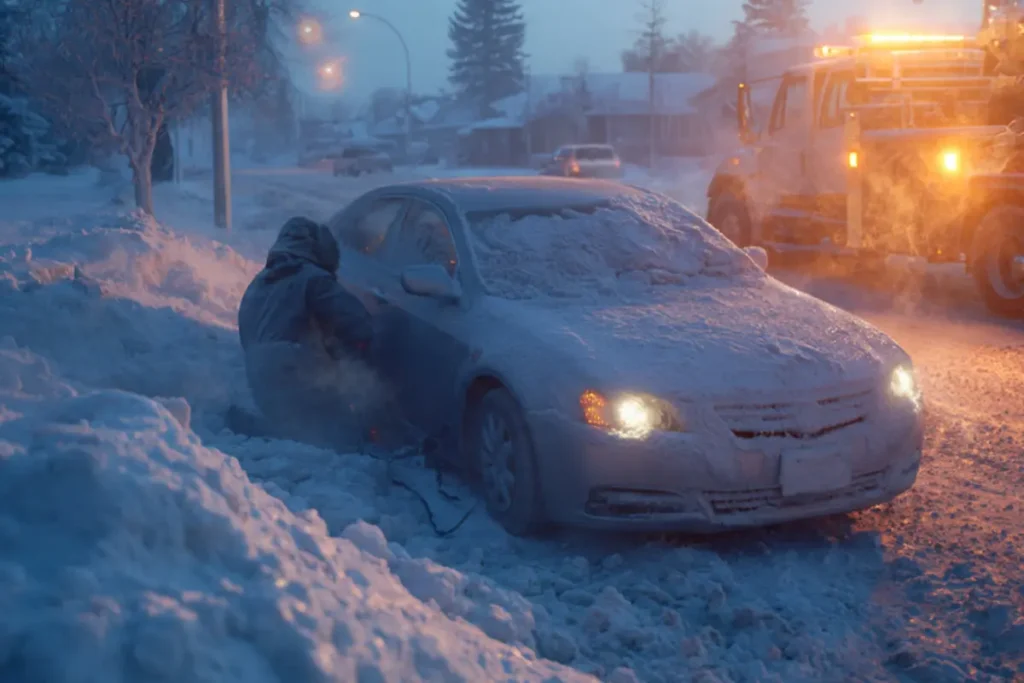
If you wake up on a January morning in Winnipeg, turn your key, and hear nothing but a weak click or total silence, your car battery has almost certainly surrendered to the cold. Winnipeg winters are not just uncomfortable for people; they are genuinely brutal on vehicle batteries. Temperatures that regularly dip to -25°C, -30°C, and sometimes lower do not just slow your battery down; they can kill it outright. The quick answer is this: cold weather dramatically reduces a battery’s ability to produce the electrical current needed to start your engine, and if your battery is already aging or partially discharged, sub-zero temperatures will finish the job overnight. Below, we break down exactly how this happens, what warning signs to watch for, and what Winnipeg drivers can do to stay ahead of a dead battery this winter.
Why Winnipeg Cold Is Especially Hard on Car Batteries
Most Canadian cities deal with cold winters, but Winnipeg sits in a different category. The city regularly experiences some of the coldest urban temperatures in the country, with extended stretches of deep freeze that last days rather than hours. This prolonged cold exposure is what separates Winnipeg winters from a typical cold snap somewhere milder.
When temperatures stay below -20°C for multiple consecutive days, battery failures compound, because extreme cold wreaking havoc on weaker or older batteries becomes almost certain after the second or third consecutive day of deep freeze. This is not just an inconvenience — it is a predictable pattern that repeats itself every winter across the city, and Winnipeg drivers need to understand why it happens to protect themselves from it.
The Science Behind How Cold Kills a Car Battery
Your car battery is not a simple power container. It is an electrochemical device that generates electricity through chemical reactions happening between lead plates and a sulfuric acid electrolyte solution inside. When it is warm out, those reactions happen quickly and efficiently. When the temperature drops, everything slows down.
Freezing temperatures slow down your battery’s chemical reaction and thicken engine oil, which means your battery is actually weaker at precisely the moment your engine needs the most power to turn over.
Here is the double blow that Winnipeg winters deliver: first, the battery itself loses significant output capacity. Lead-acid batteries can lose around 20% of their capacity in cold weather, and at extreme lows like -30°C, they can lose up to half their power. Second, thicker oil in a cold engine means the starter motor has to work much harder and draws far more current than usual. Your battery is being asked to deliver more electricity while simultaneously being able to produce less of it. That is a fight a weakened battery simply cannot win.
What Happens to the Electrolyte in Extreme Cold
The liquid inside your battery is not pure water; it is a sulfuric acid solution. A fully charged battery has a high concentration of that acid, which means it freezes only at extremely low temperatures. But a partially discharged battery has a weaker electrolyte solution. A fully charged battery freezes around -55°C, but a low-charge battery can freeze near -15°C, temperatures Winnipeg regularly experiences in winter. A frozen battery is not just dead; it can crack the battery casing and cause permanent, irreparable damage.
The Role of Summer Heat in Winter Battery Death
This surprises a lot of drivers, but many winter battery failures actually start the previous summer. High temperatures accelerate chemical reactions inside batteries, but they also accelerate battery degradation, meaning heat-damaged batteries arrive at winter with already reduced capacity, making them far more vulnerable to freezing when temperatures plummet. If your battery struggled through a hot Winnipeg summer, it may already be compromised before the first deep freeze of the season even arrives
Read This Also: How Much Does a Jump Start Service Cost in Winnipeg?
Warning Signs Your Battery Is About to Fail This Winter
Batteries rarely die without giving some warning. The problem is that most drivers either do not recognize the signals or dismiss them as minor quirks. Knowing what to look for in autumn, before temperatures bottom out, can save you from a morning crisis.
Slow engine cranking is often the first sign. If your engine takes longer than usual to turn over when you start it, your battery is struggling to deliver full current. This symptom tends to get worse as the weather cools, so a battery that cranks slowly in October is a battery that may refuse to start entirely in January.
Dimming headlights when you start the car or when you are idling at a stop are another indicator. Headlights that flicker or appear noticeably weaker than normal suggest the battery cannot maintain proper voltage output.
Dashboard warning lights appearing, particularly the battery indicator light, should always be taken seriously. A battery light going on may indicate the battery has been fatally damaged by a bad alternator, a situation that calls for a complete charging system check rather than just a battery swap.
Swelling or corrosion on the battery terminals is a physical sign of internal damage or leaking. If you notice a green or blue powdery substance on the terminals, or if the battery casing appears swollen, your battery may be near failure.
Age alone is a red flag. The average battery lasts three to five years, but that lifespan is shortening due to increased electronics in modern vehicles, making regular testing increasingly important. If your battery is approaching the four or five-year mark heading into a Winnipeg winter, get it tested before the cold arrives.
What to Do When Your Battery Dies in Winnipeg Cold
Even with the best preparation, batteries can fail suddenly. When it happens to you, the most important thing is not to panic. Here is what your options are.
Call for a Professional Jump Start Service
The fastest and safest solution when your car will not start is to call a professional roadside assistance provider. Apple Towing offers battery jump start service in Winnipeg around the clock, seven days a week, including during the worst cold snaps of the year. A trained operator arrives with proper professional boosting equipment — not just a pair of jumper cables — and can safely start your vehicle on site, whether you are in a residential driveway, an apartment parking garage, a shopping centre lot, or on the roadside.
Professional boosting equipment is particularly important for newer vehicles. Modern cars have sensitive electronics and battery management systems that can be damaged by improper jump starting, so having a trained professional handle it correctly matters.
What to Do After a Jump Start
Getting the boost is only step one. After jump starting the car, drive around for at least 20 to 30 minutes to allow the alternator to properly recharge the battery, since short idle periods or very brief trips do not fully restore the charge and can lead to gradual battery drain. If your battery dies again shortly after being boosted, or will not hold a charge at all, that is a clear sign it needs to be replaced rather than repeatedly boosted. In situations where the vehicle still refuses to start during extreme winter conditions, many drivers also rely on Fast Towing Winnipeg for emergency roadside assistance and towing support across the city.
When a Tow Is the Right Call
Sometimes a boost is not enough. If your battery is cracked, frozen, or has completely failed and will not accept a charge, driving on it is not an option. In that case, the best next step is to have your vehicle towed to a repair shop for a proper diagnostic of the battery and the broader charging system. Apple Towing provides reliable tow truck service in Winnipeg for exactly these situations, with flatbed and standard towing available for any vehicle type, any time of day or night.
How to Protect Your Battery Before the Cold Hits
Prevention is always better than a crisis. There are concrete steps Winnipeg drivers can take every autumn to reduce the risk of a dead battery during the winter months.
Get your battery tested before winter. Most auto parts stores and repair shops offer free or low-cost battery testing. Have your Cold Cranking Amps (CCA) checked — this measures how much current your battery can deliver at 0°F for 30 seconds, which is the standard measure of cold-weather starting capability. If your battery is testing below its rated CCA, replace it before the deep freeze arrives.
Park indoors whenever possible. If you have the ability to park your vehicle in a garage or underground parking, that is the single best thing you can do to protect your battery during extreme cold. Even an unheated garage significantly moderates the temperature your battery is exposed to overnight.
Use a battery maintainer or trickle charger. Using a battery maintainer or trickle charger maintains the battery at an optimal charge level, extending its lifespan and ensuring reliable performance, particularly for vehicles not driven regularly. These devices are widely available and relatively inexpensive, and they can be a genuine lifesaver during the stretches when you are not driving daily.
Plug in your block heater. This is standard advice for Winnipeg winters, and for good reason. A block heater keeps your engine warmer overnight, which means your oil stays thinner and your engine requires less current from the battery to start. This reduced demand can be the difference between starting and not starting on the coldest mornings.
Consider a battery insulation wrap. A battery insulation kit or thermal wrap keeps the battery warmer during cold snaps and can make a meaningful difference, particularly for drivers who must park outdoors year-round.
Drive regularly and for adequate distances. If your vehicle sits parked for several days at a time, the battery gradually loses charge. Starting your car at least once every two to three days and driving for at least 20 to 30 minutes — not just idling — allows the alternator to properly recharge the battery.
Replace aging batteries proactively. A battery that has been in service for four or five years heading into a Winnipeg winter is a liability. Replacing it before failure is far less stressful and less expensive than dealing with a breakdown at -35°C at 7 a.m. on a workday.
AGM vs. Standard Lead Acid: Which Battery Handles Winnipeg Winters Better?
Not all car batteries are equal in cold weather. Most vehicles come equipped with standard flooded lead-acid batteries, which are the most common and least expensive type. However, AGM batteries are designed to deliver higher CCA ratings and have lower internal resistance, making them more resilient in freezing temperatures. If you are replacing a battery and you live in Winnipeg, spending a bit more on an AGM battery is a worthwhile investment. They handle deep discharge cycles better, recover more reliably after a boost, and perform significantly better during extended cold snaps.
Frequently Asked Questions About Car Batteries in Winnipeg Winters
At what temperature does a car battery start to lose significant power? Battery performance begins to drop noticeably as temperatures fall below 0°C. By -20°C, a battery can lose 30% to 50% of its starting power, depending on its age and charge level.
Can a completely frozen battery be saved? In some cases, if the casing has not cracked, a frozen battery can recover once it warms up. However, a battery that has frozen has likely suffered internal damage and should be professionally tested before being trusted again.
How do I know if it is the battery or the alternator causing my car not to start? If your battery gets boosted but dies again shortly after, or if it will not hold a charge overnight, the problem may be the alternator rather than the battery. The alternator is responsible for recharging the battery while the engine runs. A failing alternator leaves your battery perpetually undercharged and unable to cope with cold weather demands.
Is it safe to boost a car battery in extreme cold? Yes, it is safe when done correctly with proper equipment. Professional roadside operators are trained to handle cold-weather boosts safely, including for modern vehicles with sensitive electronics.
Should I let my car warm up for a long time before driving in Winnipeg winters? Modern vehicles do not require extended idling to warm up the way older carbureted engines did. A minute or two of idle time is generally sufficient. Extended idling is less effective at recharging your battery than actually driving the vehicle.
Stranded in Winnipeg? Apple Towing Is Available Right Now
If your car battery has already given up this winter and you need help immediately, Apple Towing is available 24 hours a day across Winnipeg and surrounding areas. Whether you need a jump start at your home, workplace, or on the road, or you need your vehicle towed to a repair shop, the team at Apple Towing responds quickly and handles the situation professionally.
When temperatures in Winnipeg hit their lowest, roadside assistance calls spike dramatically, and wait times with some providers can stretch for hours. Apple Towing works to get to you as fast as possible so you are not standing in the cold longer than necessary.
Beyond battery boosts, Apple Towing also provides roadside assistance services in Winnipeg, including flat tire repair, fuel delivery, vehicle lockout service, and winch-out recovery, everything a Winnipeg driver might need when winter turns against them.
Call Apple Towing any time at +1 204-963-6202. Help is on the way.